

Plate fitting castors fix through four holes in a flat top plate, for ease of fitting to any flat-bottomed equipment. The plate spreads the weight across a wider area than a single fixing can, which makes it the most rigid fitting and the strongest - the reason most industrial castors are plate fitting. The main components are the wheel, the fork and the plate: ours are built on a pressed steel fork engineered with a double ball race, in swivel, braked and fixed versions, with a choice of white nylon, blue elastic rubber or black rubber tyre wheels. Diameters are 100mm and 125mm and ratings run from 100kg to 200kg each.
These are more robust than our budget plate range, designed to cope with the more rigorous stresses in the workplace: trucks, trolleys, bakery frames, tool stands and chests, industrial refuse bins and flight cases. For 50mm models on furniture, display units or light duty trolleys, our budget plate fitting castors are the better fit.

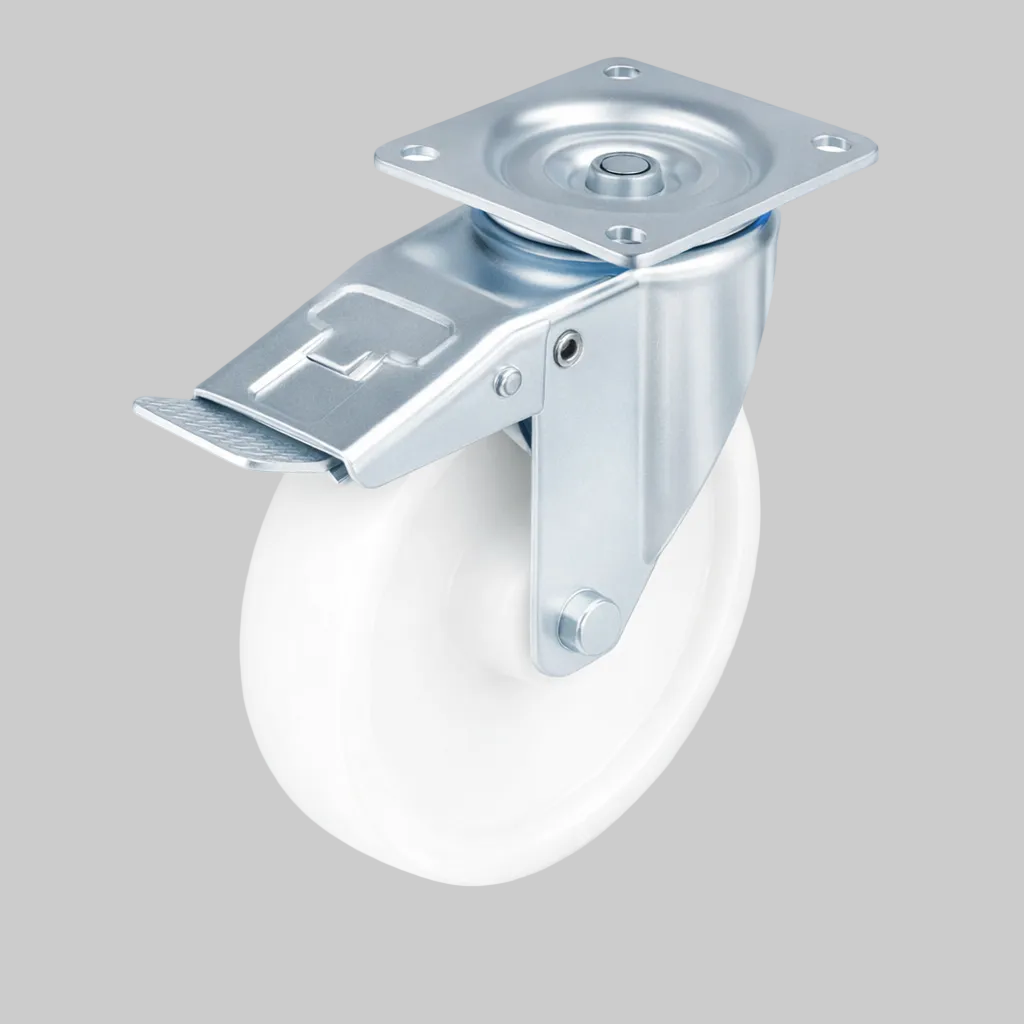

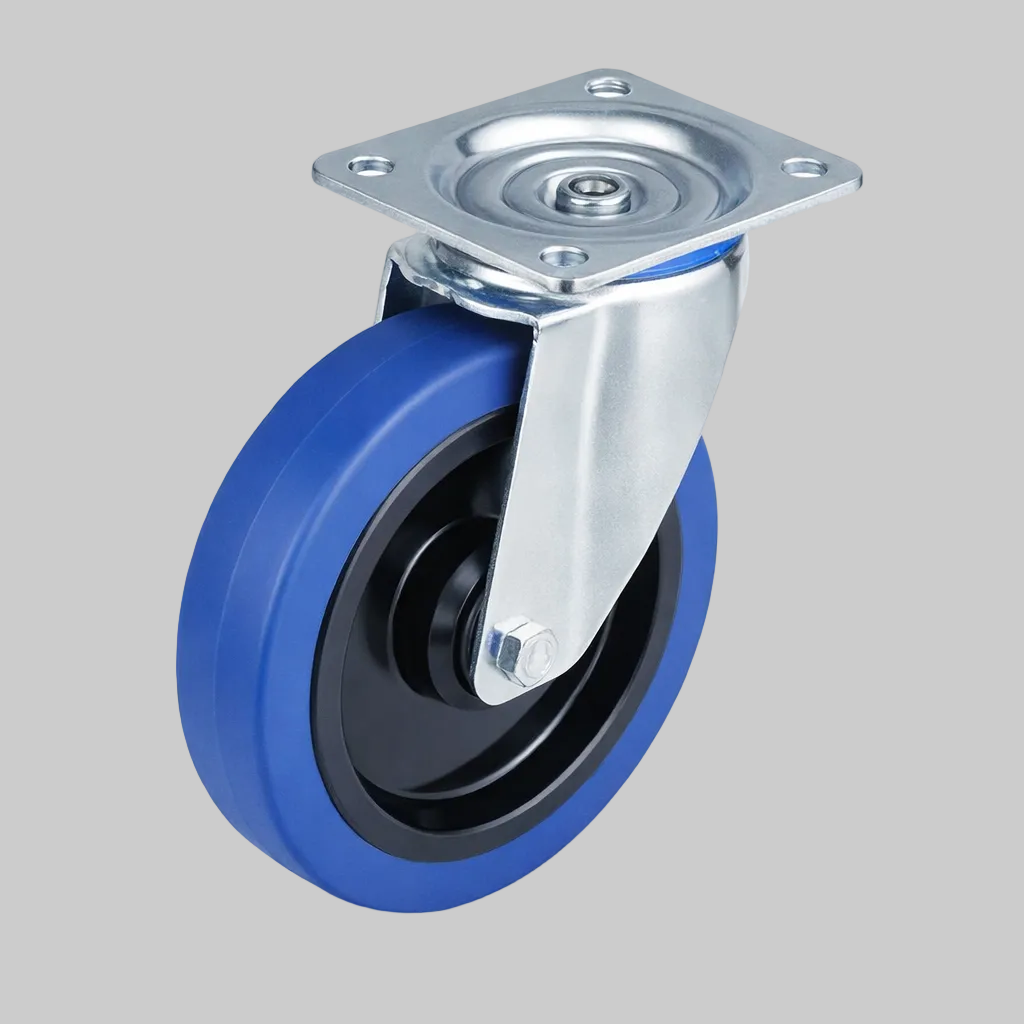
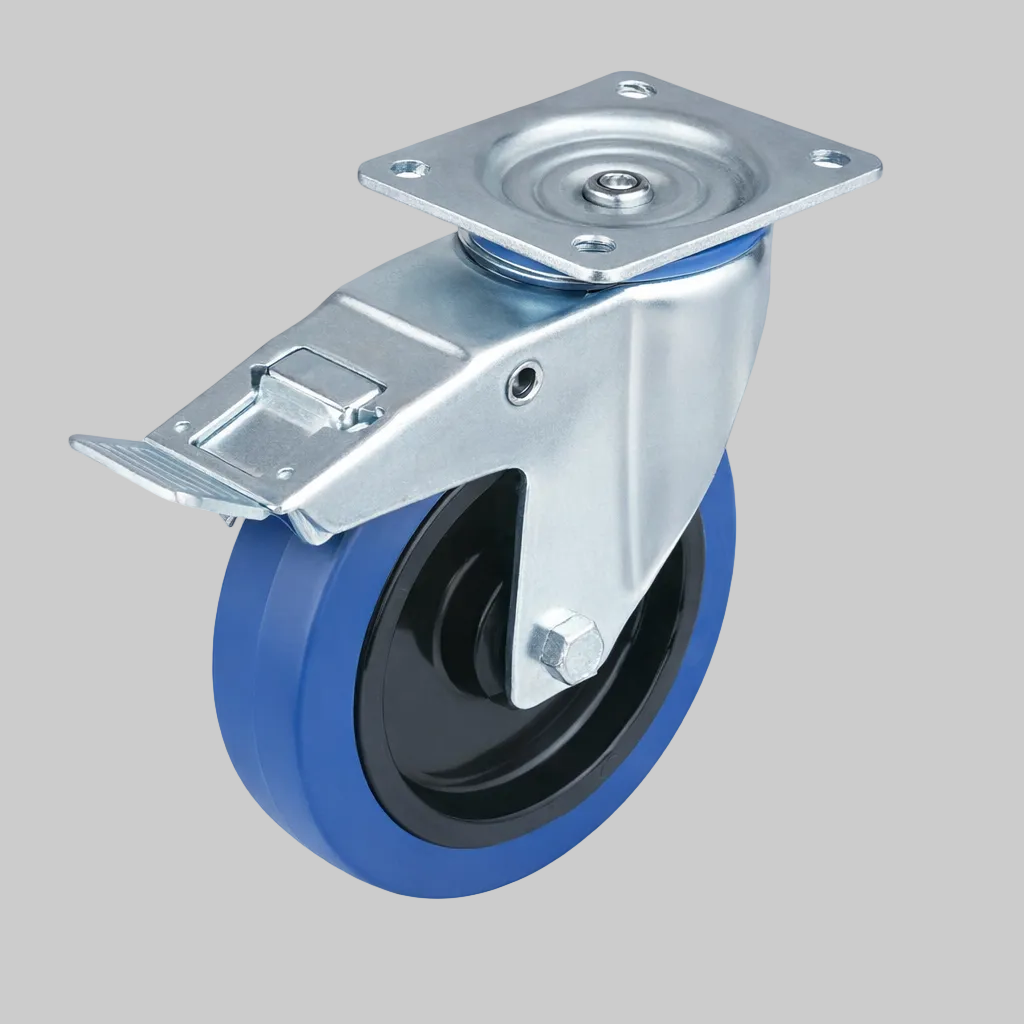
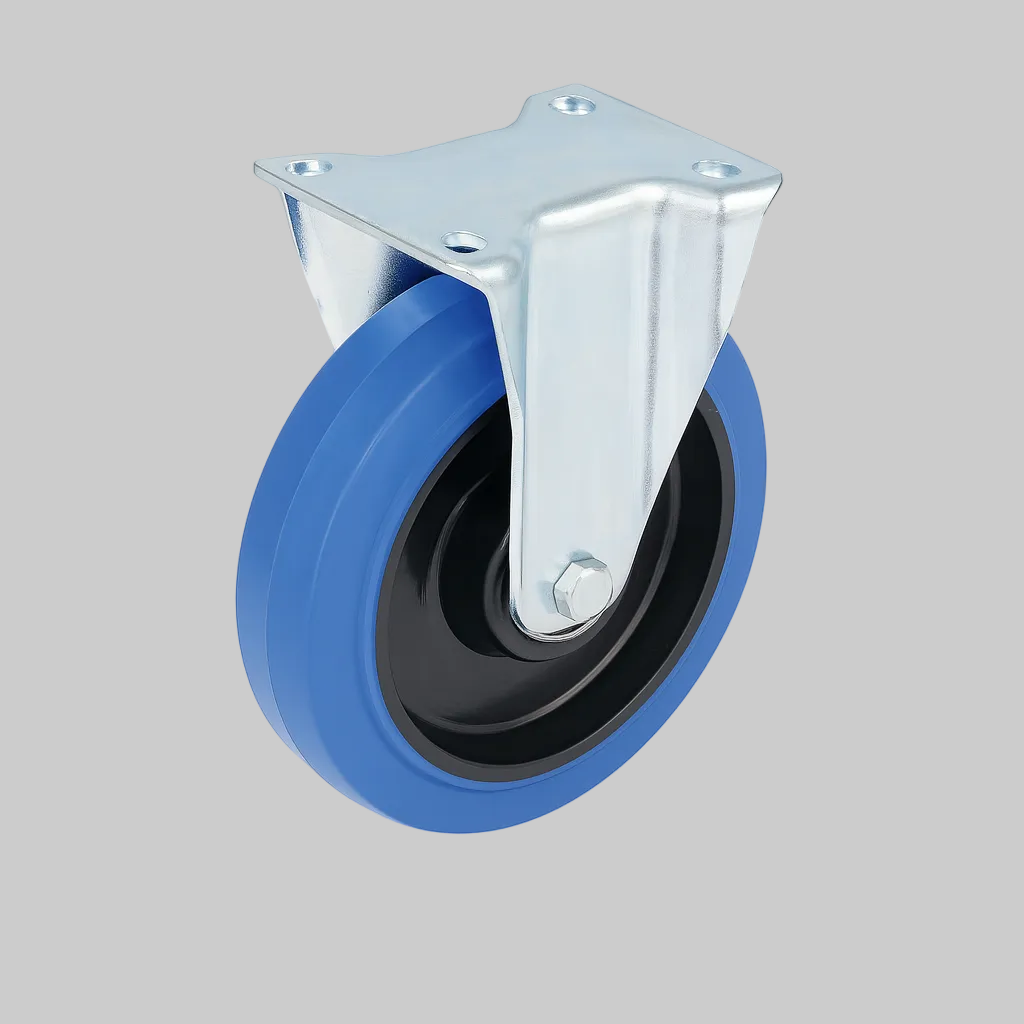
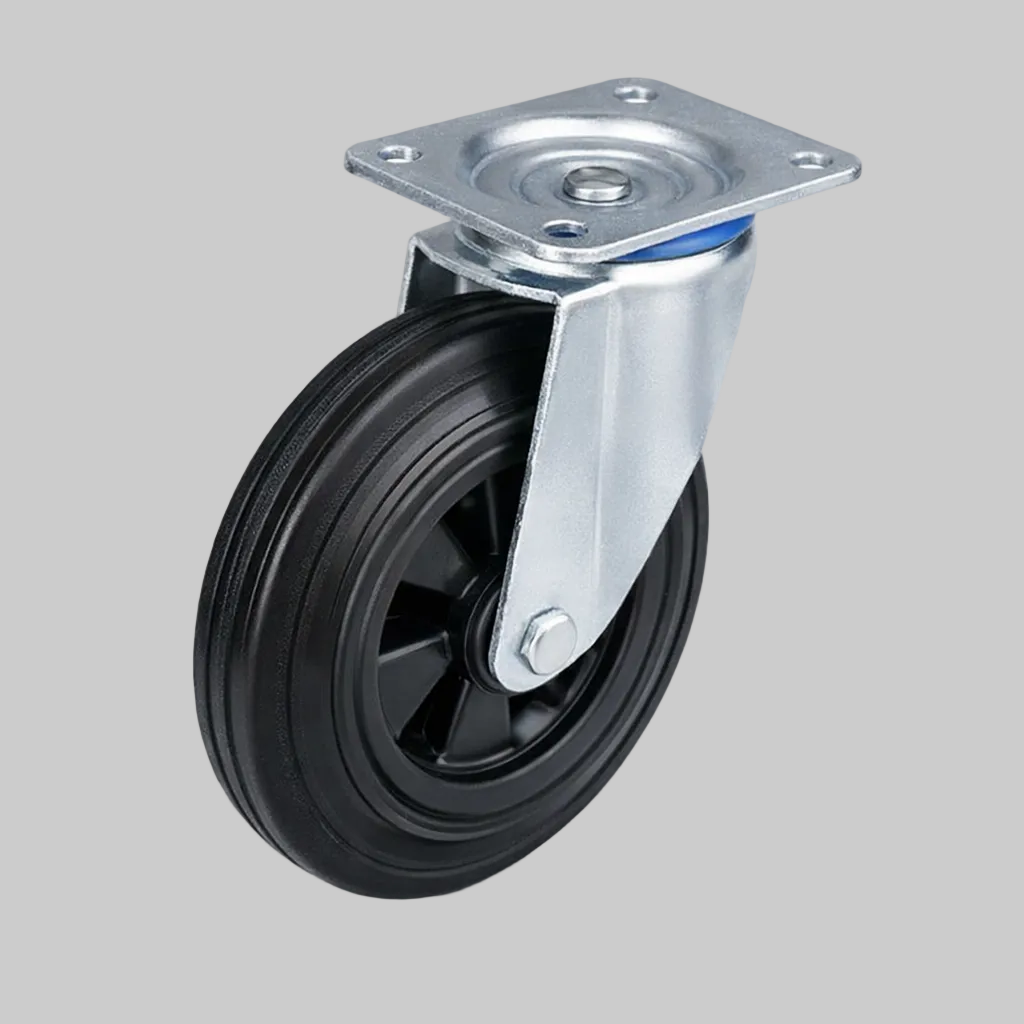
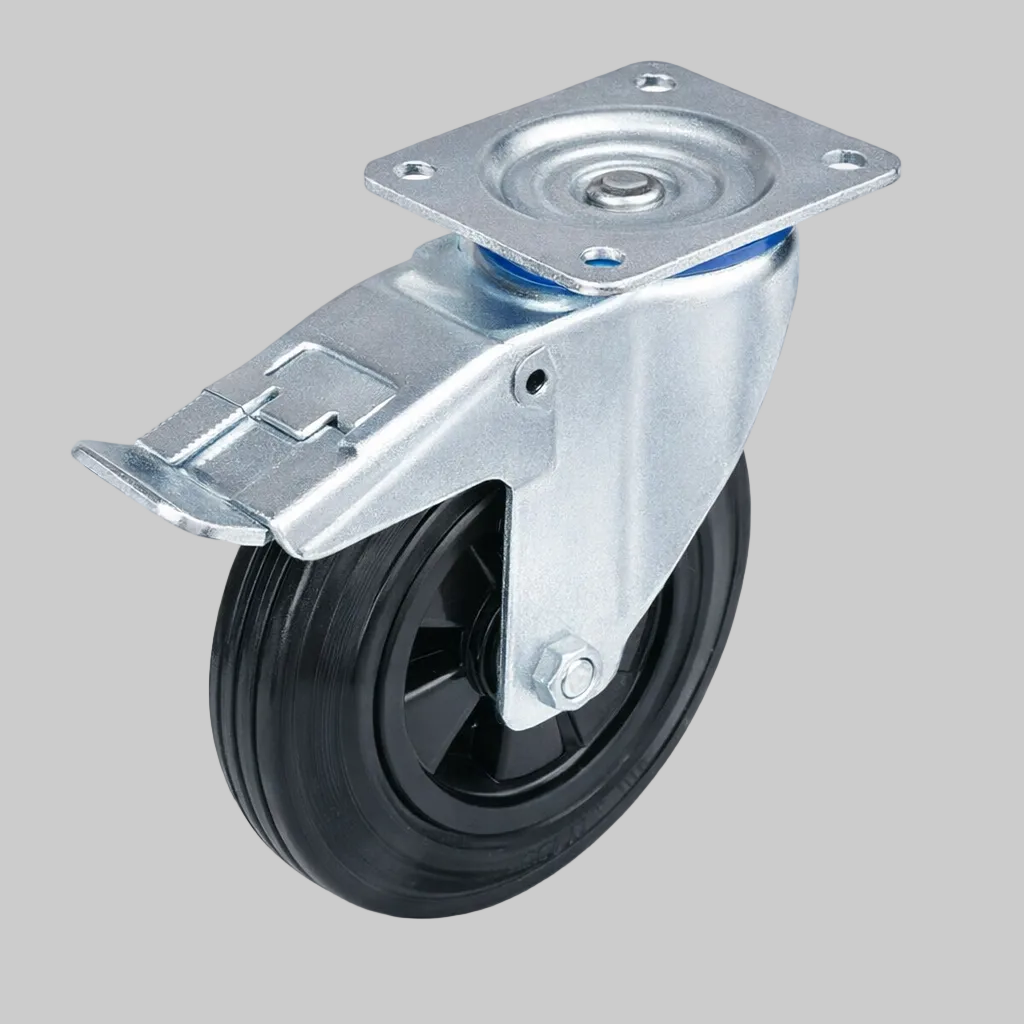
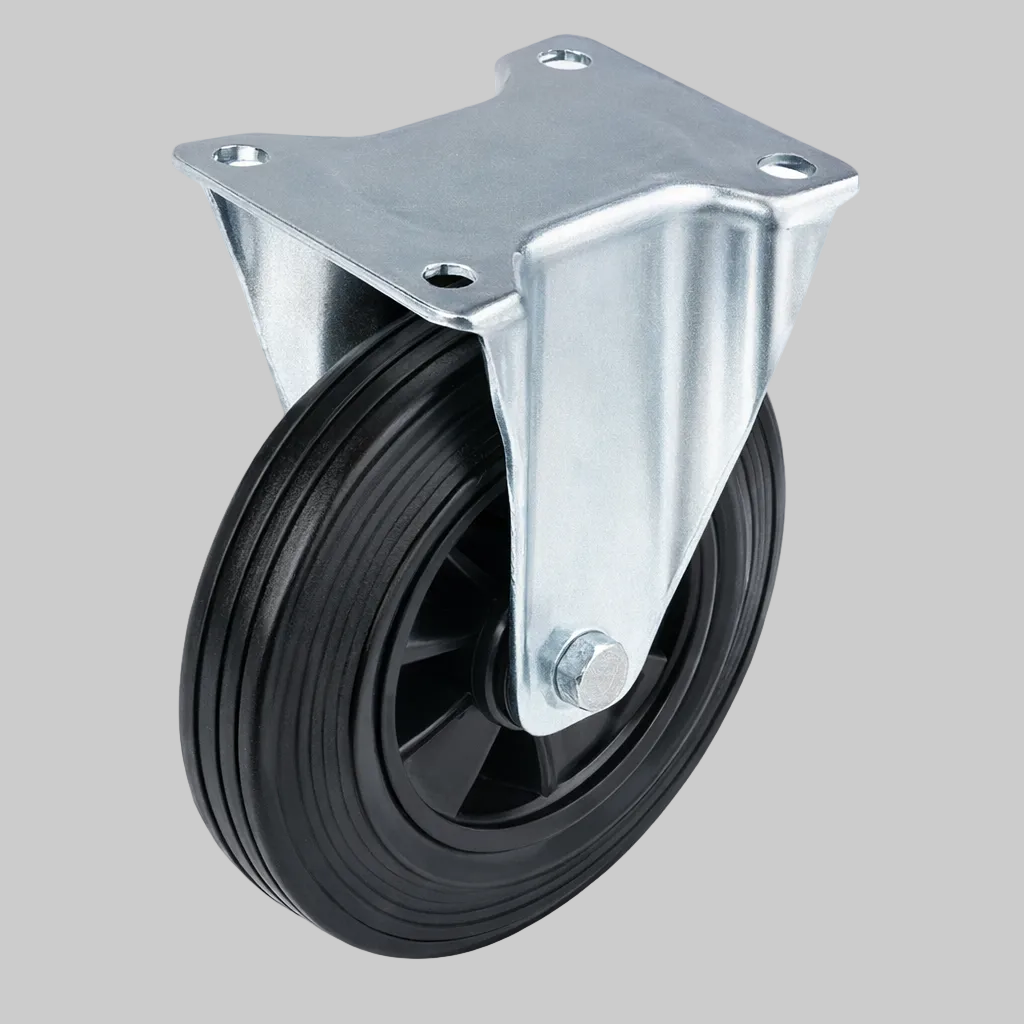
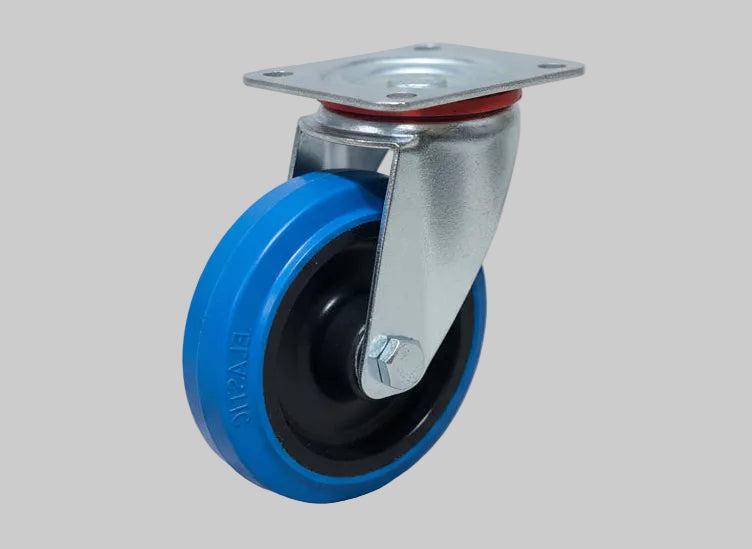
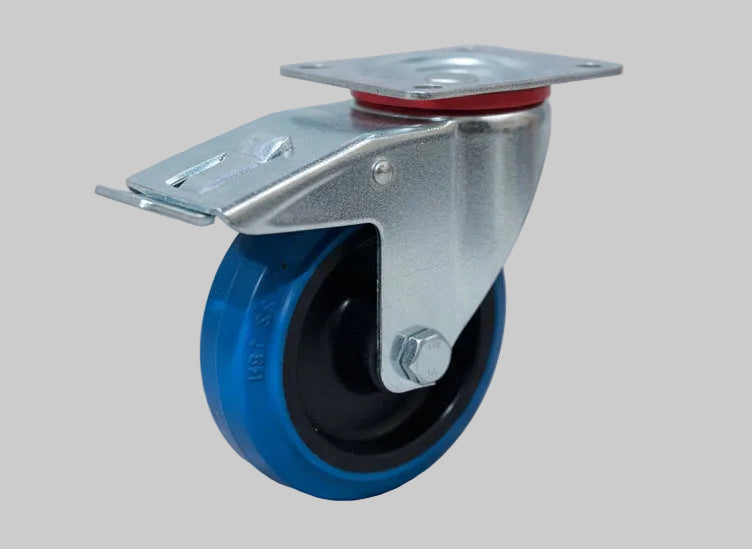
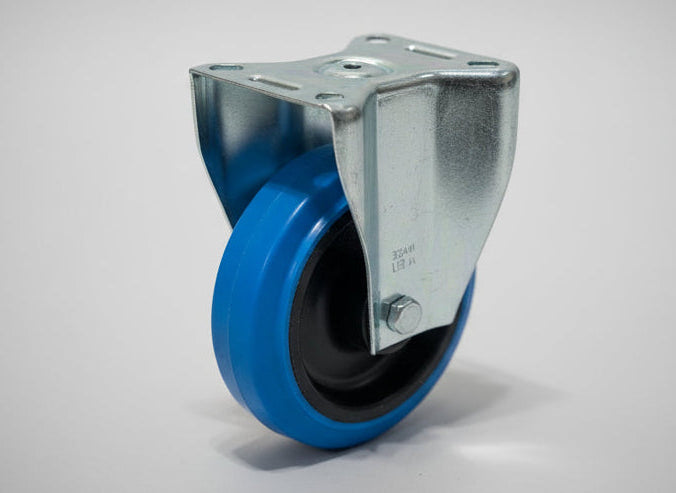
All three wheel types share the same fork and top plate, so for optimal performance the choice comes down to the floor, the weight carried and how quietly the equipment needs to run.
A hard-wearing white nylon wheel offers low friction and smooth movement on warehouse floors, with excellent wear resistance and low rolling resistance. Nylon is hard, rolls easily and carries weight well, works in wet conditions and resists chemicals, but transmits noise and can mark softer floors. The 100mm models are rated to 180kg each, in swivel, braked and fixed. Widely used across manufacturing on bakery frames, sack trucks, tool chests and tool stands. The nylon castors page covers both fittings.
Our roller bearing blue elastic models carry a hard-wearing blue elastic tyre designed to minimise vibration, ensuring quiet operation and low rolling resistance. The tyre combines the softness of rubber with easier rolling under load, which is why the trade often calls it a flight case castor - a regular choice for display cases, tool chests and medium duty industrial trolleys. The 100mm models are rated to 150kg and the 125mm to 200kg, each in swivel, braked and fixed.
A black rubber tyre reduces vibration for quiet operation with low rolling resistance, and gives good shock absorption. A popular, robust choice with many applications in the manufacturing industry: trucks, lightweight and medium weight trolleys, tool chests and refuse bins. The 100mm models are rated to 100kg. Black rubber can mark light floors; for a non marking tyre choose grey rubber or the blue elastic models above. Every rubber tyre model we make is on the rubber castors page.
Industrial top plates follow a rough trade standard. Up to 125mm, a rectangular top plate with 80 x 60mm slotted hole centres is the norm, so a worn one can usually be replaced without drilling a single new hole, and replacing like for like is easier than it looks. Institutional and medical fittings do not follow that convention - the plates are smaller and come in many patterns, so a replacement may not match the existing holes.
If you are replacing plate fitting castors on older equipment, measure the plate and the hole centres before ordering, ensuring the replacement matches, or send us a photograph and a measurement and we will identify what you need. Fixing bolts and nuts are in our hardware collection.
Read the load capacity on each product page or in the filter on this page. To work out what you need, add up the weight of the equipment plus its maximum load and divide by three, not four. On an uneven floor only three castors reliably carry the weight at any moment, so dividing by three builds in a margin. Each rating should meet or exceed that figure, and with heavy weights it pays to go up a rating: an overloaded one wears quickly and can fail without warning.
Fixed models have no swivel mechanism, so they are stronger and carry heavier weights better than a swivel model of the same wheel diameter. A stated capacity assumes rolling, not standing - equipment left loaded for months can flat-spot a softer wheel. On this page, a set of four 100kg castors carries 300kg, and four 200kg castors carry 600kg.
Swivel models rotate through 360 degrees, with the head designed so the wheel trails behind the pivot and follows the push, for ease of movement in confined spaces. Fixed models roll in one direction only and give straight line tracking. Most trolleys and carts use two of each: two fixed at one end for tracking, two at the other for steering. Fixed is only available in plate fitting, because a single central fixing would simply allow the head to spin.
Braked versions bring a locking mechanism to the turning version, essential wherever equipment must stay put when loaded or parked. The brake on these models is a combined swivel and wheel brake, holding the wheel and the head together so it can neither turn nor roll. Brakes should be rated for the same weight as the wheel. The full braked line-up across every fitting is on braked and lockable castors.
Castors are named by wheel diameter, not overall height. A 100mm model stands around 127 to 130mm tall once the fork and fitting are included, and the same applies at every diameter, so the important measurement for clearance is the overall figure in the filter on this page. A larger wheel makes rolling easier, clears obstructions and carries more weight; the cost is the extra clearance it needs. Where that is tight, our low level castors put a 120kg rating under 58mm overall, and a twin wheel castor gives more capacity at the same diameter.
The equipment decides the fitting, not preference. A top plate needs a flat surface to fix to. Where the legs are tubular with no flat surface, a bolt hole castor attaches through a single central fixing instead, and can be supplied with a solid stem or a round or square expanding adaptor for the tube. The trade-off is rigidity: it is the strongest fitting, and only a plate castor can be fixed. The same nylon, blue elastic and black rubber wheels are available in both fittings, so switching between them does not mean changing wheel.
Fixed and swivel. One tracks in a straight line, the other turns to follow the push, and a braked version puts a brake on the turning one. Most equipment uses a pair of each.
A plate fitting fixes to a flat surface through four holes. A stem inserts into a leg or tube and is common on lighter furniture and office chairs - a solid stem is specified by diameter and length, while an expanding adaptor grips inside a hollow tube. Plate fitting is the stronger of the two and the usual choice for industrial trolleys and machinery.
Work through the weight carried, the floor type, the fitting on the equipment and the clearance available. Divide the total weight when full by three for the rating each needs, match the wheel material to the floor, then check the plate and hole centres against the equipment.
Industrial models use rectangular top plates with slotted holes on standard centres, so they interchange between suppliers. Institutional, medical and furniture plates are smaller and come in many patterns that may not match one another.
Glides, felt pads and moving skates. A glide is a flat pad that lets light furniture slide on smooth floors; for a heavy object moved only occasionally, skates cost less than fitting castors. For anything heavy or moved often, there is no substitute.
Both spellings describe the same product. Castor is British English; caster is American. UK suppliers, including QED, use castor.
The majority of our wheels are moulded in the UK using our own tooling, and every product is rated honestly at its stated capacity. Order by 2pm for next day delivery. We stock a comprehensive range across every fitting for the industries we supply, and sell single castors as readily as full pallets, with volume pricing on trade and bulk purchases; for larger orders we can tailor almost any aspect, including plate size and hole spacing. For ease of ordering, prices include VAT. Our team are castor experts - if you cannot see the exact model you need, contact us and we can usually source it.